- Have any questions?
- 9650237918, 011-45872129
- info@designgurukul.in, designgurukul1@gmail.com



Vastu Tips for South-Facing Houses: Complete Guide for Homeowners
A south-facing house is often misunderstood when it comes to Vastu. The direction of the house alone does not determine whether a home is suitable or unsuitable. In Vastu, the placement of the entrance, rooms, openings, elements and internal activities also needs to be considered.
Design Gurukul approaches Vastu through the relationship between buildings, occupants, nature, environment and the forces of nature. Its Scientific Vastu approach also focuses on practical and logical planning rather than relying only on commercial products or gimmicks.
1. Pay Attention to the Main Entrance
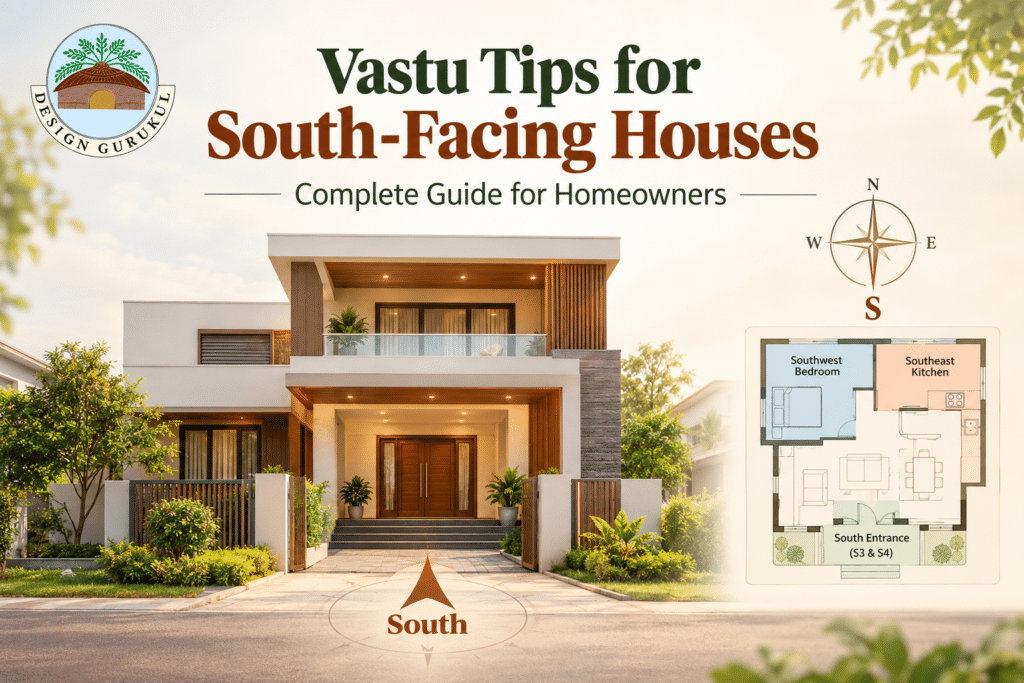
The main entrance is one of the most important areas to consider in a south-facing house. According to Design Gurukul’s Vastu guidance, the ideal south entrance positions are S3 and S4.
The main door should be superior in quality compared with the internal doors and should open inside. It should also remain free from obstruction by objects such as pillars, trees or statues.
Therefore, instead of avoiding a south-facing house altogether, homeowners should first understand the exact position of the entrance within the south side.
2. Plan the Kitchen in the South-East
The South-East is recommended by Design Gurukul as a suitable location for the kitchen. This direction is associated with heat and disinfectant energy, making it appropriate for cooking-related activities.
For better ventilation, the kitchen should ideally have adequate openings for cross ventilation. Design Gurukul also recommends placing the stove on the eastern wall so that the person cooking faces east.
The sink and stove should not be placed in a linear alignment, and heavier storage can be accommodated towards the south, southwest or west side of the kitchen.
3. Use the South and South-West for Bedrooms
South, South-West and West are suitable areas for bedrooms according to Design Gurukul’s residential Vastu guidance. These directions are associated with stability, comfort and relaxation.
For the master bedroom, the South-West is particularly recommended. The sleeping direction should also be considered. Design Gurukul recommends keeping the head towards the South, South-West or West for a peaceful sleeping environment.
4. Keep the North-East Light and Useful
The North-East has an important role in residential Vastu. Design Gurukul recommends this area for activities such as prayer and study because it is associated with concentration and connectivity.
For a south-facing home, homeowners should therefore avoid treating every corner of the house in the same way. The North-East can be planned as a comparatively open, clean and naturally comfortable part of the home.
5. Give Importance to Natural Light and Ventilation
A comfortable home needs proper daylight and ventilation along with Vastu planning. Design Gurukul’s residential guidance connects different parts of the house with factors such as sunlight, thermal comfort and natural environmental conditions.
Openings should therefore be planned carefully rather than simply being added for appearance. Proper ventilation can help maintain a healthier indoor environment, while suitable natural light can make living spaces more comfortable.
6. Avoid Unnecessary Clutter
A well-planned house should remain organised and free from unnecessary accumulation. Design Gurukul’s Vastu content repeatedly connects clean, uncluttered spaces with better environmental flow and functionality.
In a south-facing house, this means paying attention not only to the entrance but also to furniture placement, storage, circulation and the usability of each room.
7. Look at the Whole House, Not Just the Direction
One of the most important points for homeowners is that “south-facing” does not describe the complete Vastu condition of a property. The entrance position, room functions, openings, internal planning, surroundings and other directional factors need to be assessed together.
Design Gurukul’s Scientific Vastu approach considers factors including land, location, environment, building analysis and directional analysis, rather than depending on a single feature of the property.
Conclusion
A south-facing house does not need to be rejected simply because its front faces South. The more useful approach is to examine how the house is planned and how different activities are distributed throughout the building.
From selecting an appropriate entrance position such as S3 or S4, to planning the kitchen in the South-East and bedrooms towards the South, South-West or West, Vastu can be incorporated into the design of a home in a structured way.
For homeowners considering a new property, renovation or Vastu assessment, understanding the complete layout rather than focusing on direction alone can provide a more practical starting point.
Learn more about Scientific Vastu and Vastu-based building planning with Design Gurukul. The institute describes its approach as research-based, practical and focused on creating natural, healthy and Vastu-friendly buildings.