- Have any questions?
- 9650237918, 011-45872129
- info@designgurukul.in, designgurukul1@gmail.com



Returning to Nature’s Law: Where Ancient Wisdom Meets Living Science

In an age of rapid construction and faster lifestyles, we often forget a simple truth that nature already knows the answers. Nature’s laws are not outdated philosophies; they are timeless principles quietly guiding us toward balance, health, and sustainability. At Design Gurukul, we believe that the future of architecture lies not in overpowering nature, but in learning to work with it.
Scientific Vastu™, climatology, biophilic design, and regenerative frameworks may appear different on the surface, yet they speak a common language – the language of sun paths, wind movement, water cycles, vegetation, and human physiology. Under the guidance of Dr. R. M. Mehra, this integrated understanding forms the foundation of how we teach, design, and build at Design Gurukul.
Ancient Vedic texts such as Manasara viewed buildings as energy harmonizers. They prescribed proportions, orientations, and spatial relationships that encouraged light, ventilation, and thermal comfort. Today, modern simulations confirm what our ancestors intuitively knew these principles can reduce energy consumption by 20–30%. Across India, from Rajasthan’s climate-responsive havelis to Kerala’s shaded verandas and courtyards, vernacular architecture stands as living proof of this wisdom.
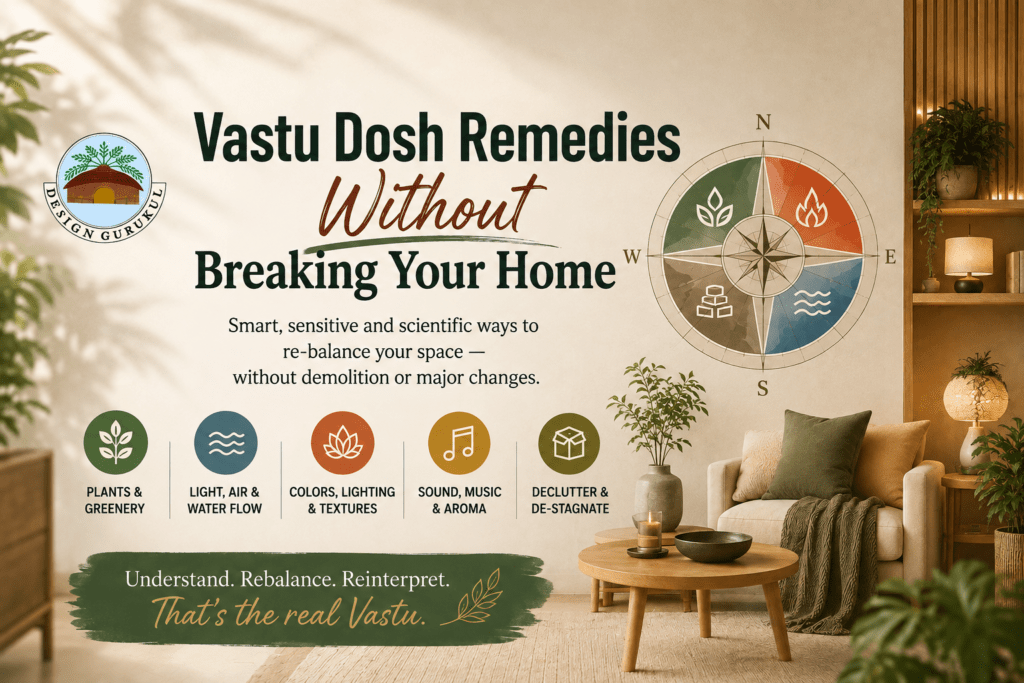
In practice, balance begins with the five elements – earth for stability, water for cooling, fire for warmth and light, air for flow, and space for openness. When homes are oriented to welcome winter sunlight, shaded from harsh summer rays, and enriched with plants, water, and breathable spaces, something remarkable happens. The building begins to support life, not drain it.
Beyond energy efficiency, the benefits are deeply human. Natural rhythms reduce stress, greenery restores calm, indoor air quality improves, and regenerative metrics like net-zero energy and healthy CO₂ levels become measurable realities.
As climate challenges grow louder, returning to nature’s law offers more than a solution. It offers a way of living that is resilient, conscious, and quietly joyful.